
Body Type Calculator
The Body Type Calculator is designed for females to find their "body shape," which can be used for getting targeted outfit Ideas. Even though there is some research linking certain body shapes with some health risks, the body shape result of this calculator is not intended to be a serious indication of health or an ideal that must be met. Instead, the waist-hip ratio, which is also shown in the results of this calculator, is a better indicator of health.


When measuring, be sure to stand straight with arms to the side. Make sure the tape is snug against the body, but not too tight such that it compresses the body (making the measurement inaccurate).
Bust size—the circumference measured around the chest over the fullest part of the breasts, while wearing a properly fitted bra.
Waist size—the smallest circumference measured around the natural waist, just above the belly button.
High hip size—the circumference of the upper swell of the hip over the pelvic region. It is around 7 inches (18 cm) below the natural waist.
Hip size—the largest circumference measured around the hips over the largest part of the buttocks.
Female body shapes in the fashion industry
In the fashion industry, body shapes are often categorized into four classes.
Apple, or inverted triangle
This body shape describes a person who has broader shoulders and bust than they do hips.
Banana, straight, or rectangle
This body shape describes a person who typically has waist measurements that are less than 9 inches smaller than the hip or bust measurements.
Pear, spoon, bell, or triangle
This body shape describes a person who has hip measurements greater than their bust measurements.
Hourglass, X shape, triangles opposing, or facing inwards
This body shape (typically presented as the "ideal") describes a person with hip and bust measurements nearly equal in size, with a narrower waist measurement.
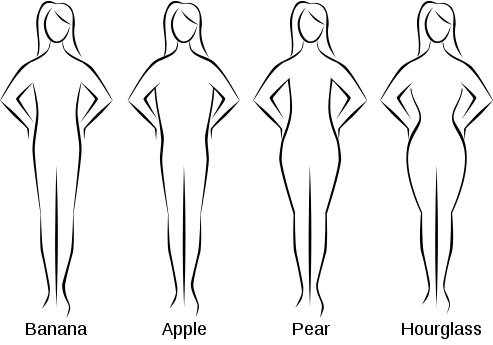
A study of more than 6,000 women conducted at North Carolina State University in 2005 revealed that 46% of women were banana-shaped; just over 20% were pear-shaped; just under 14% were apple-shaped; and only 8% were hourglass-shaped.
What is my body shape?
The female body shapes are based on societal standards that are subjective and are different in different cultures. The algorithm used in this calculator is based on a study published in the International Journal of Clothing Science and Technology, which breaks down the body shapes of women into 7 categories1. There are very wide ranges of actual sizes within each shape. Also, some body shapes may not fit into any of the shapes listed below.
Hourglass
If (bust - hips) ≤ 1" AND (hips - bust) < 3.6" AND (bust - waist) ≥ 9" OR (hips - waist) ≥ 10"
Bottom hourglass
If (hips - bust) ≥ 3.6" AND (hips - bust) < 10" AND (hips - waist) ≥ 9" AND (high hip/waist) < 1.193
Top hourglass
If (bust - hips) > 1" AND (bust - hips) < 10" AND (bust - waist) ≥ 9"
Spoon
If (hips - bust) > 2" AND (hips - waist) ≥ 7" AND (high hip/waist) ≥ 1.193
Triangle
If (hips - bust) ≥ 3.6" AND (hips - waist) < 9"
Inverted triangle
If (bust - hips) ≥ 3.6" AND (bust - waist) < 9"
Rectangle
If (hips - bust) < 3.6" AND (bust - hips) < 3.6" AND (bust - waist) < 9" AND (hips - waist) < 10"
Waist-hip ratio
Waist-hip ratio (WHR) is defined as the ratio of waist circumference to hip circumference. The value is calculated by dividing waist measurement by hip measurement. A person with a 34" waist and 40" hip would therefore have a waist-hip ratio of 34/40, or 0.85. Waist-hip ratio is sometimes used as an indicator of certain health conditions. Research has shown that people with more weight around their waist, or who have "apple-shaped" bodies, are at higher risk than those with more weight around their hips, or who have "pear-shaped" bodies. According to the National Institute of Diabetes, Digestive and Kidney Diseases (NIDDK), women with WHRs above 0.8 and men with WHRs above 1.0 have higher health risks as a result of their fat distribution.
WHR is also used as a measurement of obesity. The World Health Organization (WHO) defines males with a WHR above 0.90 and females with a WHR above 0.85 as obese. This corresponds to a body mass index (BMI) above 30. Obesity can be an indicator of a number of serious health conditions such as hypertension, coronary heart disease, diabetes, some cancers, and more. WHR has been found to be more effective than both waist circumference and BMI for predicting mortality in people above the age of 75; WHR has also been found to be a better predictor of cardiovascular disease than both these measures. According to a study by Yusuf S, et al.2, were obesity to be re-defined based on WHR rather than BMI, the proportion of people who would be categorized as being at risk of heart attack would increase three times.
Abdominal fat (which corresponds to people with "apple-shaped" bodies) has been found to result in higher health risks than other peripheral fat. A higher WHR indicates more abdominal fat, and the higher the ratio, the higher the risk of potential health complications. Refer to the Body Fat Calculator for more information regarding different types of fat and the risks associated with being overweight or obese.
WHR is also correlated with fertility, with different values being optimal for males and females. Females with WHRs above 0.80 have been found to have significantly lower pregnancy rates than those with WHRs between 0.70 and 0.79. Studies have also shown that men with WHRs around 0.9 are more fertile, tend to be healthier, and also have a lower chance of both prostate and testicular cancer.
Aside from the associated health risks, WHR has also been studied in relation to cognitive ability, as a measure of female attractiveness, and even in relation to food composition in a diet.
- Lee, J.Y., Istook,C.L., Nam, Y. J., and Park, S. M.,, "Comparison of body shape between USA and Korean women", International Journal of Clothing Science and Technology, Vol.19, No.5, 2007, pp.374-391.
- Yusuf S, Hawken S, Ounpuu S, Bautista L, Franzosi MG, Commerford P, Lang CC, Rumboldt Z, Onen CL, Lisheng L, Tanomsup S, Wangai P, Razak F, Sharma AM, Anand SS (November 2005). "Obesity and the risk of myocardial infarction in 27,000 participants from 52 countries: a case-control study". Lancet. 366 (9497): 1640-9.
The Somatotype Illusion: Why Your Body Type Calculator Results Demand Nuance
A body type calculator cannot dictate your metabolic rate, muscle-building ceiling, or fat-loss destiny. The three somatotypes—ectomorph, mesomorph, and endomorph—were developed in the 1940s by psychologist William Sheldon to link physical structure to psychological temperament, a concept modern science has entirely discarded. Yet, fitness culture adopted the structural half of his theory. Today, calculating your body type serves a singular, practical purpose: it provides a starting baseline for matching training volume to your natural leverages and recovery capacity. It does not predict your future.
The real-world decision problem that drove the creation of somatotype calculators was trainer frustration. Coaches needed a shorthand system to explain why two clients eating the exact same macros and lifting the exact same weights experienced vastly different physical adaptations. Rather than explaining complex myosin heavy chain distributions or insulin sensitivity variances, trainers used "ectomorph" and "endomorph" as communication shortcuts. The calculator exists to automate that shortcut.
The Anti-Consensus Wedge: You Are Not One Body Type
The most pervasive assumption driving the use of these calculators is that humans fit neatly into one of three distinct boxes. We do not. In clinical physiology, we observe somatotype distributions on a continuous 7-point scale, not a categorical triad. A person rarely presents as a pure 1-1-7 (extreme endomorph) or 7-1-1 (extreme ectomorph). Most individuals present as a mixed phenotype, such as a 4-5-3, indicating moderate mesomorphic traits with slight endomorphic and ectomorphic tendencies.
Assigning yourself a single label leads to a behavioral trap known as self-categorization theory. If a calculator labels you an "endomorph," you subconsciously lower your cardiovascular output expectations because the label implies a genetic predisposition to sluggishness. If labeled an "ectomorph," you might prematurely abandon progressive overload, blaming "bad genetics" when your plateau is actually a result of under-eating protein. The calculator gives you a data point. Your brain incorrectly assigns it a identity.
Physiological Blueprint: What the Calculator Actually Measures
When you input your wrist circumference, ankle girth, height, and weight into a body type calculator, the algorithm is estimating your skeletal frame mass relative to your total mass. It is a crude proxy for bone density and joint surface area.
Frame size dictates mechanical leverage. A wider clavicle (mesomorphic trait) provides a longer lever arm for the pectoralis major and lateral deltoids, making pressing movements mechanically more efficient. Conversely, narrower joints (ectomorphic trait) mean the tendon inserts closer to the joint axis, requiring more absolute force production from the muscle belly to move the same load. Understanding this helps you choose appropriate starting weights and exercise selections, rather than fighting your own skeletal geometry.
Clinical Ranges: Where Somatotypes Intersect With Medical Standards
While somatotypes are not clinical diagnoses, the physical characteristics they describe correlate strongly with metabolic health markers. The World Health Organization (WHO) and the Centers for Disease Control and Prevention (CDC) do not use somatotypes, but they track the anthropometric outcomes typically associated with them.
| Health Metric | Standard Population Range (CDC/WHO) | Athletic Population Observation | Risk Outside Healthy Range |
|---|---|---|---|
| Body Mass Index (BMI) | 18.5 - 24.9 kg/m² | 25.0 - 29.9 (due to lean mass) | <18.5: Bone density loss, hormonal suppression. >30: Insulin resistance, cardiovascular strain. |
| Waist-to-Hip Ratio (WHR) | <0.90 (Men) / <0.85 (Women) | 0.80 - 0.85 (Men) / 0.70 - 0.75 (Women) | Exceeding thresholds indicates visceral adiposity, independent of total body fat. |
| Waist Circumference | <102 cm (Men) / <88 cm (Women) | Varies heavily by sport (e.g., strongman vs. marathon) | High correlation with metabolic syndrome and Type 2 diabetes risk. |
| Body Fat Percentage (DEXA) | 10-22% (Men) / 20-32% (Women) | 6-12% (Men) / 13-20% (Women) | <5% (Men)/<13% (Women): Endocrine disruption. >25% (Men)/>33% (Women): Inflammatory markers rise. |
The critical takeaway from this data is the "Athletic Population Observation" column. A heavily muscled mesomorph will routinely register as "Overweight" on the standard BMI scale. If a mesomorphic individual uses a standard BMI calculator alongside a body type calculator, the data will appear contradictory. This is why body type calculators must be viewed as complementary tools, not standalone diagnostic instruments.
Risk and Benefit Analysis: Interpreting Your Results
If your results indicate a predominantly endomorphic structure, you face a specific set of physiological trade-offs. You possess a higher baseline number of fat cells (adipocytes), which means your body is chemically very efficient at storing caloric surplus. The benefit? You have excellent metabolic reserves for high-volume, endurance-based training, and your joints are well-cushioned for heavy compound lifting. The risk? Your adipose tissue secretes higher baseline levels of inflammatory cytokines. If you carry excess weight, the inflammatory load is multiplicative, not additive, compared to an ectomorph carrying the same percentage of body fat.
For the ectomorphic result, the trade-off reverses. You have highly sympathetic nervous system dominance, meaning you burn calories rapidly at rest. The benefit is a naturally low baseline of visceral fat and high insulin sensitivity. The risk lies in nutrient partitioning during stress. When an ectomorph enters a severe caloric deficit or faces high psychological stress, the body lacks sufficient stored energy to maintain reproductive hormone production. Clinically, we see this manifest as hypothalamic amenorrhea in women or suppressed testosterone in men, even at seemingly "healthy" BMI levels.
The mesomorphic structure sits in the middle, but it is not without flaws. High natural muscle mass increases resting metabolic rate, but it also increases baseline oxygen consumption and oxidative stress. Mesomorphs often underestimate their recovery needs because they adapt quickly to novice training stimuli, leading to early-stage overtraining syndromes within their first two years of serious lifting.
Measurement Accuracy and Tool Limitations
A digital body type calculator relies entirely on the accuracy of your self-reported circumferences. A 1-centimeter error in wrist measurement can shift your calculated somatotype significantly, because the algorithm uses small denominators (wrist/ankle ratios) to extrapolate whole-body structure.
Furthermore, calculators cannot account for age-related sarcopenia or fluid retention. A 55-year-old former athlete might input measurements that yield an "endomorph" result, when in reality, their skeletal frame is mesomorphic, but they have lost 15 pounds of muscle and gained 10 pounds of subcutaneous water due to declining growth hormone levels.
This calculator does not measure body composition. To contextualize your results, you must pair them with a bioelectrical impedance analysis (BIA) scale, or ideally, a DEXA scan. If the body type calculator labels you an endomorph, but a DEXA scan shows you are 18% body fat with significant lean mass, the calculator’s structural assumption is overridden by your actual tissue composition.
Knowledge Graph: Your Next Logical Calculations
Isolating your body type without connecting it to energy expenditure renders the data useless. Once you establish your structural baseline, you face a decision tree regarding energy balance.
If you calculate a high-protein, moderate-fat diet using a Macronutrient Calculator, but you ignore your endomorphic tendency to partition carbs into adipose tissue, you will gain fat despite hitting your protein goals. You must cross-reference your somatotype with your Total Daily Energy Expenditure (TDEE). Specifically, look at the "Activity Multiplier" in your TDEE calculation. If you are an endomorph, subtract 100-150 calories from the standard TDEE output to account for lower Non-Exercise Activity Thermogenesis (NEAT), which clinical data consistently shows is lower in individuals with higher baseline fat mass. Conversely, ectomorphs should add 150-200 calories, as their fidgeting and spontaneous movement burn significantly more untracked calories.
The 3-Step Action Plan by Result Level
Pathway A: The Ectomorphic Baseline (Narrow Frame, Fast Metabolism)
Step 1: Optimize the Force-Velocity Curve. Stop defaulting to high-rep, low-weight isolation work. Your narrow joints are built for rapid force production. Shift 70% of your training to compound movements in the 4-6 rep range, focusing on progressive overload. If you choose this path, you gain raw strength and dense muscle tissue, but you lose cardiovascular conditioning. Accept that trade-off for the first 12 months.
Step 2: Liquid Caloric Loading. Your high sympathetic nervous system activity suppresses appetite during stress. Relying on whole foods alone often leads to accidental under-eating. Incorporate one liquid carbohydrate-protein shake daily containing 600-800 calories. This bypasses the mechanical satiety signals in your gut.
Step 3: Cap Cardiovascular Volume. Limit steady-state cardio to two sessions per week, capped at 30 minutes. Excessive cardio will burn the caloric surplus you need for tissue synthesis.
Pathway B: The Mesomorphic Baseline (Athletic Frame, Efficient Recovery)
Step 1: Periodization Over Specialization. Because you adapt quickly to training stimuli, your nervous system plateaus faster than other body types. Structure your year into distinct 8-week blocks: hypertrophy, strength, and power. If you try to maintain all three simultaneously, you gain moderate results in all categories but fail to reach your actual structural potential.
Step 2: Targeted Mobility Work. Your rapid muscle growth often outpaces fascial elasticity, leading to impingement issues (particularly in the shoulders and hips). Dedicate 15 minutes post-workout to loaded stretching. The trade-off: this adds time to your sessions, but prevents the 4-6 week layoffs caused by typical mesomorphic overuse injuries.
Step 3: Macronutrient Cycling. Match your carbohydrate intake to your training density. On high-volume days, increase carbs by 25%. On rest days, reduce carbs by 25% and increase fat by 15%. This prevents the slow, insidious fat gain that plagues mesomorphs in their late 20s and 30s as metabolic rate naturally declines.
Pathway C: The Endomorphic Baseline (Wider Frame, Slower Partitioning)
Step 1: Prioritize NEAT Over Formal Cardio. Formal cardio burns calories for 30-60 minutes. NEAT burns calories constantly. Aim for 10,000 to 12,000 steps per day before adding a single treadmill session. The math is asymmetric: walking 10,000 steps burns roughly 400-500 calories, requires zero recovery time, and does not spike cortisol like intense cycling or running does. Intense cardio spikes cortisol, which in endomorphic profiles, actively promotes visceral fat storage when in a caloric deficit.
Step 2: Carbohydrate Periodization. Do not eliminate carbohydrates. Instead, restrict them to a 3-hour window immediately post-workout. During the rest of the day, rely on protein and dietary fat for satiety. This manipulates insulin sensitivity, forcing your muscles to uptake glucose efficiently when they are most receptive, preventing spillover into adipose tissue.
Step 3: Mechanical Tension Focus. Avoid high-rep, high-burn "metcon" style weightlifting. Your joints are built for load, not high-frequency repetitive stress. Choose heavy loads, lower reps (5-8), and longer rest periods (2-3 minutes). This maximizes mechanical tension on the muscle, which yields the highest post-exercise oxygen consumption (EPOC) without the inflammatory joint damage of high-rep fluff work.
Why This Data Requires Human Judgment
Algorithms process inputs. They do not observe context. A body type calculator does not know if your wide waist measurement is due to subcutaneous fat, a congenitally wide pelvis, or bloating from untreated Small Intestinal Bacterial Overgrowth (SIBO). It does not know if your narrow wrists are genetic, or the result of low testosterone during your developmental years due to chronic illness.
Use the calculator to establish your mechanical leverage profile. Use the clinical ranges table to ensure your anthropometrics remain within healthy boundaries. Then, apply the specific action plan that matches your output. Re-evaluate your metrics every 90 days. As you add muscle or lose fat, your somatotype score will shift. The goal is not to permanently live inside a categorical box, but to use the box as a temporary scaffold to build a more resilient, capable body.
Medical Disclaimer: This guide is for informational and educational purposes only. It is not a substitute for professional medical advice, diagnosis, or treatment. Always consult a qualified healthcare provider before beginning any new diet, exercise regimen, or making changes to your health management, particularly if you have underlying health conditions or are taking medications.